
Modern project environments are more connected than ever.
And yet, in many organizations, planning and execution still happen in completely separate systems.
Schedules are built in one platform.
Teams execute work somewhere else.
Progress updates live in spreadsheets, boards, emails, meetings, and reporting layers spread across multiple tools.
Over time, this disconnect creates friction across the entire organization.
Not because teams are not working hard enough.
But because work stops flowing cleanly between planning and execution.
That is one of the core problems LYNX-X was designed to solve.
The Disconnect Between Planning and Execution
For many organizations, project planning and daily execution evolved separately over time.
Planning environments became highly structured:
- schedules
- dependencies
- buffers
- resource allocation
- portfolio oversight
Execution environments became more flexible:
- task boards
- cards
- Agile workflows
- team collaboration tools
Individually, both environments can work well.
The problem appears in the gap between them.
When planning and execution are disconnected:
- updates become duplicated
- visibility becomes delayed
- reporting becomes reactive
- priorities drift
- teams lose alignment
- managers spend more time coordinating than improving flow
Eventually, organizations stop managing execution proactively and start managing exceptions constantly.
This is where complexity begins to slow delivery.
More Tools Did Not Solve the Problem
Many organizations attempted to solve this challenge by adding more tools, more dashboards, or more reporting layers.
But adding more systems often increases fragmentation instead of reducing it.
Information becomes scattered across environments.
Teams switch continuously between tools.
Project data becomes outdated faster.
Operational visibility decreases instead of improving.
The result is an environment where:
- planning feels disconnected from reality
- execution feels disconnected from strategy
- decision-making becomes slower
- teams spend more time maintaining systems than moving work forward
The issue is not a lack of information.
It is a lack of operational continuity.
Why Flow Matters
In complex project environments, successful delivery depends on flow.
Flow means:
- priorities stay aligned
- dependencies remain visible
- updates move quickly
- execution reflects the plan
- teams can focus without unnecessary friction
When flow breaks down, organizations experience:
- delayed escalation
- hidden bottlenecks
- overloaded resources
- coordination fatigue
- constant firefighting
Trying to regain control through more reporting or oversight often creates even more operational drag.
Modern project environments need something different.
They need connected execution.
Bringing Planning and Execution Together in LYNX-X
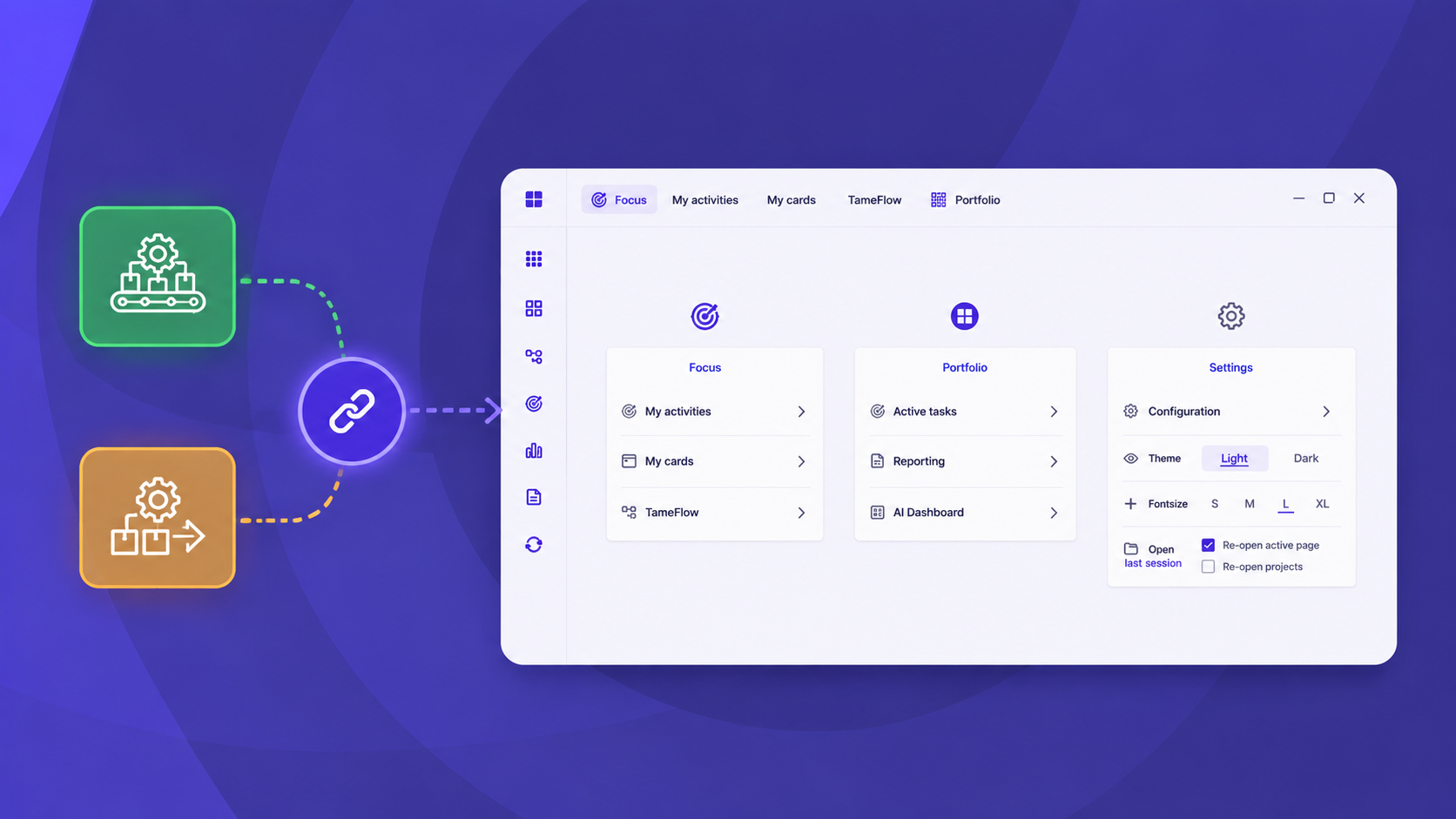
LYNX-X was designed around the idea that planning and execution should work together inside one connected environment.
Instead of separating scheduling from execution workflows, LYNX-X combines them into a unified system.
Teams can:
- build schedules
- manage buffers
- oversee resources
- monitor portfolio performance
- execute work with boards and cards
- follow progress in real time
all within the same environment.
This creates stronger alignment between strategy, planning, and execution.
It also reduces many of the operational inefficiencies caused by disconnected systems:
- fewer duplicate updates
- less manual coordination
- clearer visibility
- faster communication
- better prioritization
- smoother execution flow
Planning no longer exists separately from the work itself.
The system continuously supports execution as projects move forward.
Clarity for Teams and PMOs
One of the major advantages of connected environments is that different roles can focus on the information most relevant to them.
Teams need clarity around:
- daily activities
- tasks
- execution priorities
Project managers and PMOs need visibility into:
- portfolio health
- resource usage
- delivery performance
- emerging risks
LYNX-X supports both perspectives through focused, role-based views designed to reduce noise and improve operational understanding.
Teams stay focused on execution.
Leadership maintains visibility across the broader project environment.
Both layers stay connected.
Reducing Friction Across the Organization
Project complexity cannot always be reduced.
But operational friction can.
When planning and execution exist inside one connected environment:
- communication becomes simpler
- updates move faster
- priorities become clearer
- visibility improves naturally
- teams spend less time coordinating across disconnected systems
The result is not just better oversight.
It is smoother delivery.
Built for Modern Multi-Project Environments
Today’s organizations rarely operate within a single methodology or tool ecosystem.
Agile workflows, structured schedules, portfolio management processes, and enterprise delivery systems all need to coexist.
LYNX-X is designed for that reality.
The platform integrates with environments such as Jira, Azure DevOps, and Microsoft Project while helping organizations maintain alignment between planning and execution layers.
Rather than forcing organizations into disruptive process changes, LYNX-X helps connect the systems and workflows teams already rely on.
One Connected System
Planning and execution were never meant to operate separately.
The more disconnected project environments become, the harder it becomes to maintain flow across teams, portfolios, and strategic initiatives.
LYNX-X was built to close that gap.
One connected environment.
One operational flow.
One system designed to help teams move strategic work forward with greater clarity, visibility, and focus.
LYNX-X
When transformation cannot fail.
